Sunday, July 17, 2016

Clearing the Air

Ours is a sobering reality that we can expect to see and hear only bad news whenever we tune in to current events broadcasts. But it would be incredibly ignorant to deny that over the past few years — and particularly the last few months — the news has grown increasingly grim. Although I hesitate to introduce politicizing material, in the United States we are experiencing frightening levels of civil unrest stoked by concerns over terrorism, immigration policies, police brutality, racial tensions, gun violence, economic turmoil, and of course the tremendously polarizing — and I daresay pessimistic — 2016 presidential election. I will not trouble with citing specific instances, as they are too many to list. (If any of this sounds unfamiliar to you, would you kindly give me directions to the mammoth rock under which you have been living?) This volatile combination of confusion, misunderstanding, disagreement, anger, and vengeance has coalesced into a brand of hatred that is forced to find expression in displays of escalating intensity and greater tragedy, a hatred that has poisoned the proverbial air we breathe.

http://ichef-1.bbci.co.uk/news/660/media/images/80660000/jpg/_80660988_americanmasks.jpg
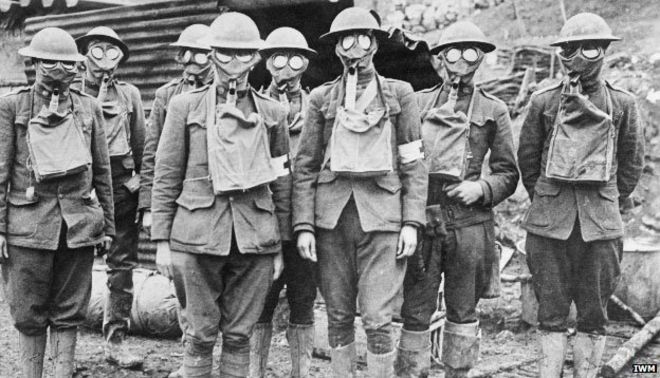
American WWI soldiers donning gas masks
I recently read an (old) report in Chemical & Engineering News marking the 100-year anniversary of the first successful deployment of poison gas as a weapon of mass destruction. While by far not the first act of chemical warfare in history, the April 22, 1915 release of chlorine gas on woefully unprepared Allied troops entrenched near Ypres, Belgium claimed in excess of 8100 casualties — of which over 1100 were fatalities — and set a lethal precedent for armies and regimes to follow. In addition to tear gases, phosgene, and diphosgene, the debilitating blistering agent known as mustard gas was uniquely dangerous in that it had a delayed effect, which meant that soldiers could unknowingly contaminate their camps upon return from the battlefield. Chemical agents were responsible for relatively few WWI fatalities — less than 1% — but they produced grisly images of human (and ecological) suffering. These poison gases made inhospitable the spaces they occupied, not unlike the animosity which plagues our present social climate...

Perhaps the archetypal symbols of this chemical warfare are the gas masks worn by infantryman (and their animal counterparts), like those shown above. It is a fear-invoking image, a horrifying deformation of the human countenance (one that, disappointingly, seems to have been romanticized in the steampunk culture). And rightly so, as it is a reminder of the terrible things that armies introduced to humanity to yield devastating results. Moreover, the masks were quite uncomfortable. But they served as necessary protection, protection that enabled soldiers to overcome the hazards of this new shade of warfare. Is it surprising, then, that people would require protection against the evil and hatred which permeates our present lives?
http://image.dek-d.com/27/0082/5116/117539232
A typical medieval plague doctor costume
I remember thinking a while back how strikingly similar (and visually unsettling) the gas masks worn by WWI infantryman were to the masks worn by plague doctors during the Middle Ages. In that time, the miasma theory of disease was predicated on the belief that illness was propagated by the movement of miasma or "bad (or night) air" generated by the decay of organic matter. To prevent the transmission of disease, doctors placed scented substances [including ambergris lemon balm, mint leaves, camphor, cloves, laudanum, myrrh(!), rose petals, and storax] and straw as a filter in the cone nose. Consequently, these doctors sought to keep out the "bad air" by filtering it and replacing it with other scents. Consider further how modern doctors and other medical professionals — who have come to adopt the germ theory of disease — use appropriate facial protection when treating patients. Or how firefighters wear oxygen masks to brave the cocktail of harmful substances they encounter at structure fires. Although the everyman is less likely to encounter these physical hazards, I very much believe that the aura of hatred which contaminates our goodwill as human beings is actively choking us out. So what is our protection?

The answer seems obvious to me: the Word of God. Now, I do not mean that holding a sacred book to one's mouth and nose will shield a person from some kind of "miasma." Instead, it is in the living out of the Word, through acts of love and mercy, that we guard our hearts against the "wickedness and snares of the Devil" (from the Prayer to Saint Michael the Archangel) and in so doing can work to dispel that air of evil. In taking in the "breath of life" (see Genesis 2:7), a life force free of the corruption of human sinfulness, we are strengthened by God's grace to triumph over the toxic and soul-killing enmity that threatens to suffocate us all.

It should be said, this "mask of protection" is not an easy one to wear. To have the courage to stand against the rising tide sets one apart and can be off-putting (read: frightening) for those who have decided to follow the current. Consequently, this Christian bravery can be burdensome, and there are no doubt times that we will desire to wrench it off and embrace the alluring ease of evil. In my opinion, this is one of the great paradoxes of our faith: That we are promised an "easy yoke" (Matthew 11:30) but must be willing to "take up [our] cross" (Matthew 16:24). Yet, infinitely more unbearable is the burden of hate that will bury us in the end.

I proffer these two musical pieces for reflection, one more serene and the other (from my favorite Christian band) more impassioned:


From both, we see that it is only the sweetness of God's love that can fill our spirit with true goodness. If we ignore that love, we fall. But if we immerse ourselves in it, we become the greatest possible versions of ourselves. It is then our Christian duty, as vessels of God's love, to go forth and "breathe" new life into a diseased world. And in the fullness of time, with fervent hope, we will be able to remove our masks and breathe forever freely.

Thursday, March 24, 2016

The Penitent's New Clothes

As we near the end of the Lenten season, we look forward to the celebration of Easter and the resurrection of Jesus. It is an occasion for joy! But until that time, it is important we remember to reflect upon our failings to live as Christ calls us to live and to seek forgiveness for our transgressions through acts of sacrifice and penance. On Sunday, we recounted Jesus' triumphant entry into Jerusalem, how He was welcomed with the waving of palm branches and the proclamation of praises: “Blessed is the king who comes in the name of the Lord. Peace in heaven and glory in the highest” (Luke 19:38). And yet, this is the same crowd that will condemn Him in four days' time, sentencing Him to death in a most brutal fashion (cf. Luke 23:18-25).

Any self-respecting Christian will say that (s)he loves Jesus. The question is, how often do we betray that love for Jesus? The simple answer: Whenever we sin. Whenever we decide to disobey God's commandments in efforts to satisfy our own selfish ends — either by doing something we know to be wrong (sin of commission) or deliberately failing to do something we ought to (sin of omission) — we become like the duplicitous crowd. I have no doubt that any person other than Jesus would find such treachery virtually inconceivable to forgive. Thank God (quite literally) that the love and mercy of Christ are inexhaustible. But we can only receive that forgiveness if we are truly repentant; that is to say, we must strive with every fiber of our being to cast off the evils which plague us. The trouble is, sin (by its very nature) can be very tempting.

I have found a compelling metaphor for the destructive, parasitic power of sin in Sam Raimi's Spider-Man 3 (2007). (CAUTION: I will do my best to avoid spoiling the movie, but there are some significant elements that I will need to reference.) Now, by many accounts, the third film in Raimi's trilogy fell short of the expectations set by its predecessors. However, it contains some profound moral truths on the consequences of indulging in powers we cannot honestly hope to control. Take, for instance, the scene where Peter Parker falls under the influence of the alien symbiote...


Much like the symbiote slinking along the floor towards an unsuspecting Peter, sin creeps into our lives in the form of temptation, concealing the evil it comprises. The devil often tries to seduce us when we are in a weakened state — tired, frustrated, sad — just as the symbiote is drawn to Peter, who is clearly restless and agitated in the above scene. These are the times ripest for temptation, and the evil one makes certain to exploit our vulnerabilities. If we do not continuously guard against the allure of sin, then we are certain to fall.

When sin does take hold, it darkens our soul. While this darkening is not as visual as the transformation of the Spider-Man costume, it possesses a very real power over our physical and spiritual being. At its worst, sin can make us feel empowered, perhaps liberated from the limitations set by our conscience and sound moral reasoning. By embracing sin, we may feel like we are in control of it, master of its power, not unlike Peter. A particularly subtle example is a grudge: One might believe he is in control, but the fact of the matter is that those angry feelings will eventually become a greater and greater detriment to his inner peace. (Guilty. I blame my Italian/Irish/German roots.) And then the hammer comes down...


There is some superb symbolism here. To start with, the scene takes place in a church [a Catholic church, no less (inferred by the presence of the corpus on the crucifix)], God's dwelling place and a house of healing, where we come to seek forgiveness and reconcile ourselves with the Father. Peter has come to realize how he has become corrupted and enslaved by his newfound "power," and he now fights with all his might to extricate himself from the clutches of this evil controller. The symbiote is nothing short of resistant to this attempt; it takes the tolling of the bell — an audible representation for the glory of God — to weaken the creature enough for Peter to rend it off. Indeed, it takes deep strength and humility to recognize the negative impact of sin, to confess wrongdoing, and to struggle to remove and banish sinful tendencies from our lives. And yes, that struggle can be quite painful, leaving us feeling exhausted and perhaps beaten. But with the grace of God we can learn to combat temptation and become our fullest selves.

[I would also like to remark on Eddie Brock's fate. His is a reminder that we need to be mindful of how we pray. Without giving too much away, Eddie had legitimate grounds for being upset with Peter. He made a good first step by walking into a church and seeking God. Where he went wrong is that he prayed for Peter's (presumably agonizing) death. Jesus teaches us that we must love and pray for our enemies, as difficult as that is. (Consider Christ's prayer on Calvary in Luke 23:34.) When we instead wish ill upon them, even if the original offense was theirs, then we become like monsters, our humanity polluted by sin.]

Stripped of the "garments of evil," what are we to wear instead? The prophet Isaiah speaks of "garments of salvation" and "a robe of justice" (Isaiah 61:10). St. Paul instructs us to "put on the new self," renewed in the virtues of "heartfelt compassion, kindness, humility, gentleness, and patience," forgiveness, peacefulness, thankfulness, wisdom, and above all love, "the bond of perfection" (cf. Colossians 3:10-16). This is alone made attainable by Jesus' sacrifice at Golgotha, the culmination of His Passion, which we memorialize and reenact in our celebration of the Easter Triduum. In an act of love impossible to fathom, Christ gave His life to destroy the eternal death warranted by our transgressions. By the shedding of His blood, our souls are cleansed. The obvious reference I can make is to the Elect in Revelation 7:9-17, who "have washed their robes and made them white in the blood of the Lamb." And while a white garment is a classic illustration of purity and freedom from sin, I would like to propose another article of "clothing" befitting the "new self..."

https://pastorjesusfigueroa.files.wordpress.com/2015/10/maxresdefault.jpg 

In his letter to the Ephesians (6:10-17), St. Paul urges his audience to defend itself not against "flesh and blood" but against "the world rulers of this present darkness, with the evil spirits in the heavens." To this end, he enjoins the people to don the "armor of God" in order to "stand firm against the tactics of the devil." In beautiful metaphorical language, St. Paul tells the people to equip themselves "with your loins girded in truth, clothed with righteousness as a breastplate, and your feet shod in readiness for the gospel of peace. In all circumstances, hold faith as a shield, to quench all [the] flaming arrows of the evil one. And take the helmet of salvation and the sword of the Spirit, which is the word of God." The soldier in me finds this illustration quite captivating, and I deem it remarkably appropriate as a representation of the revitalized sense of mission we ought to feel upon reconciling ourselves to the Father. We are made strong in God's love, and no matter how many chinks we make in the armor or their size we can always return to Him to ask him to mend our broken selves. We are called to be warriors for Christ, and so Jesus, with a "refiner's fire" (cf. Malachi 3:2-3), is always willing to smith and repair our armor if we approach Him with contrite hearts and a loving spirit.

Archbishop Fulton J. Sheen once remarked, "Unless there is a Good Friday in your life, there can be no Easter Sunday." If we are unwilling to accept our failings and die to ourselves, we cannot experience the joy of the Resurrection. But as the prophet Joel says, "Rend your hearts, not your garments, and return to the LORD, your God, for he is gracious and merciful, slow to anger, abounding in steadfast love, and relenting in punishment" (Joel 2:13). For the Lord will bestow on us a "new self," a self purified of sin and provisioned with the grace to "resist on the evil day and, having done everything, to hold your ground" (Ephesians 6:13). May God bless you upon the conclusion of this Lenten season, and may you have a glorious and Happy Easter!

Friday, January 29, 2016

How We Survive

It is said that the voice of God can be found in many places. In the sweet chatter of birds, the laughter shared between friends, the silence of a dark room... The Lord speaks to us in countless and often unexpected ways. But I was especially surprised to hear Him speaking in a most unlikely place: through the lyrics of a high-octane, metalcore song.

Friends of mine might know that hard rock and metal are among my favorite genres of music — a preference that may seem to conflict with a Christian lifestyle, but skeptics might find an amusing example in the work of Fratello Metallo — so I am always delighted whenever I discover a musical piece with a powerful sound and a message which, intentionally or not, speaks to the God-seeking heart. Such was the case when I heard Wage War's "Twenty One." An intense piece which reflects on the trials and tribulations of growing up, I was nearly floored by a few key lines that made a subliminal reference to the trust we are told to place in God's loving mercy. (Even so, I do not expect it to be endorsed by the Holy See any time soon.) I would like to explore with you through a Christian lens that hidden, if not entirely deliberate, message in the style of a Genius post.

For those who would like to hear the song, I have inserted the official music video below. WARNING: As a metalcore piece it is loud and has a heavy sound; those readers with finer sensibilities may wish to skip ahead. I have reproduced the lyrics (with friendly edits) from the YouTube page below the clip.


They say that there's no hope
Don't think, do what you're told... No
 
An obvious declaration of defiance, these lines sound as though they are coming directly from the mouth of an angst-ridden teenager who has had his fill with being told to conform to a certain set of expectations. In our spiritual lives, how often have we (erroneously) felt that the tenets of Christian living have pigeonholed us into a rigid kind of existence? Sought to defy those principles in order to pursue what we believed was actually best for ourselves? There is a word for that: sin. We are all guilty of it.

There is a second way we can interpret these lyrics. The devil, working through the manifestation of evil in the world, tries very hard to convince us that there is no hope for deliverance. In this way, he hopes to close our minds to the workings of evil and lure us into the state of complacency which holds many of our brothers and sisters captive. Do we have the courage to then challenge the devil and turn back to God?

We've lost our way
Abandoned foundations on which we were made
We're all dying of the same disease
I looked for the answer and the problem was me 

Any honest Christian will admit to the fact that he/she has been led astray by temptation and sin, forsaking the holiness to which the Lord has called him/her. We are modeled in the image and likeness of God, and yet by our own free will we choose to renounce this rock of salvation (cf. Psalm 62) to seek a different path, only to find ourselves traveling in endless, self-destructive circles. Our waywardness is the unfortunate consequence of original sin — the "same disease" — and it has indeed cost us our bodily immortality. Mercifully, by the grace of God we are able to seek reconciliation for our transgressions. But until we do so we need to be wary of one of the devil's favorite lies: that we cannot be forgiven. In the performance of the song, the sense of desperation and finality of a sinful state is quite evident in the delivery of this stanza, especially in the first line. 

[Bridge]
All along we've been searching for a place to call our home
You and I will never learn if we try to do this on our own

In all our longings in this life there is one common denominator: the desire to find somewhere — or someone — who will take us in and give us the safety and security that we so earnestly crave. It is a basic human need to feel loved and in the fullest possible way; that is, in the way that only the Almighty can provide. We devote so much of our energies towards finding this sense of belonging, even in unholy pursuits. As the Catholic novelist Bruce Marshall once wrote (the quote is often incorrectly attributed to G. K. Chesterton), "The young man who rings the bell at the brothel is unconsciously looking for God."

The second line of the bridge is pretty straightforward. Try as we might, we can never hope to understand our longings unless we are humble enough to admit our ignorance and seek help from God through the inspired wisdom and experiences of His people. Says a Danish proverb, "He who is afraid of asking is ashamed of learning."

[Chorus]
Underneath it all we are all the same (All the same)
Never knowing where to go, lost in our way
Can we ever escape? Can we decide our fate?

Echoing the earlier sentiment that we are all alike in our brokenness, the chorus explicitly raises the question of whether or not we can put an end to our cyclic waywardness and come to travel the righteous path. Our earthly journey is riddled with doubt, so escape from our sinfulness can seem unattainable. A certain fallen angel would undoubtedly celebrate a surrender to doubt. But the vigilant Christian knows that surrender to a higher authority is what enables him/her to overcome these uncertainties and free him/herself from the bonds of sin.

Let go...
I'm more than familiar with feeling like I've failed to meet everyone's expectations

When every definition of success becomes different, it's hard to really feel like you're making a difference

This portion appears to mark the beginning of a shift in the speaker's thinking. He seems to recognize an emptiness in the world's demands, demands that can be so dissimilar that it becomes impossible to satisfy anyone. Consequently we cannot find a sense of fulfillment. In such a scenario, all we are left with is a feeling of loss and failure. This is not the life God intends for us.

They say that there's no hope
Don't think, do what you're told
Dare to be different, to break the mold
Live your life with intention, go forth and be bold

With a feral yell that announces the speaker's realization of the madness that plays out in this world, the song's opening lines are reproached and completely turned on their head. As Christians we are set apart as "a chosen race" (cf. 1 Peter 2:9) to stand out. This becomes a very daunting task in a society that demands complacency towards the state of affairs. It is all the more daunting when that same society celebrates diversity but selectively discriminates against particular groups and philosophies. Nonetheless, we are told to "be strong and steadfast," to "not fear nor be dismayed," because the Lord has promised to walk with us throughout the journey (cf. Joshua 1:9). It takes great courage to be different for God, but that is the calling bestowed on us in our baptismal vows.

[Bridge]

Why do we try to overcomplicate the things that used to be so simple? 
So step back, you'll be able to see that your purpose in life is not just to be

The outrage in these lyrics — and not to mention their sick (in the positive sense of the word) rhythmic delivery — are unmistakable. Much in life is complex, but in hearing this first line I am inclined to think of how we as people have an unfortunate tendency to complicate relationships in every form: relatives, friends, partners, etc. We frequently set unfairly high expectations for people, especially for those to whom we feel close (or want to be close). This can lead to broken relationships, and then we brood over them as they continue to deteriorate without our efforts to mend them. As these relationships languish their complexity only compounds with our desire to fix them running counter to the instinct to preserve our pride. And we wind up being angry and confused.

Because Christ instructed us to live with a simple, childlike faith (cf. Matthew 18:2-4) we ought to embrace opportunities for simplicity. The love of God is perfect; therefore, elegant; therefore, simple. This is the kind of love that we should feel for one another, not one that manufactures unreasonable expectations. Relationships need to grow and evolve naturally, a difficult truth to accept when we as human beings want things to transpire in a particular way on our timescale. Even so, to secure our relationship to the Father He asks for only one simple thing from us: everything. Our understanding of and participation in that love develops with time and patience, but the conditions for starting along that road could not be more clearly defined.

Are we as children of God called to live a passive existence? Far from it. Jesus tells us that he "came so that [we] might have life and have it more abundantly" (John 10:10). Moreover, we are entrusted with spreading the Good News, "glorying the Lord by your life" (that should sound familiar to all you churchgoers). It is impossible to comprehend the gravity of this summons and not feel compelled to act upon it. In baptism we share in Christ's inheritance to the Kingdom of Heaven, but it requires some work on our part. Says St. Francis of Assisi, "Preach the Gospel at all times and when necessary use words." This is how we participate in God's love.

[Chorus x 2]

I've come to grips with the fact that I'll never be able to change my own past

But I've found strength in divine perspective
It took me twenty one years to realize: Hope, Love, and Faith are how we survive
Grace sustains me, pain has ending... There's still hope

These are the lines that grabbed my attention. While we are alone powerless to make recompense for our past trespasses, God has blessed us with the tools to move beyond our transgressions. Of course, it takes time for us to grow and reach spiritual maturity (hence, "twenty one years"), but as we approach this stage — though I would argue we never quite achieve it until we see the Father face-to-face — we come to realize that "faith, hope, [and] love remain" (1 Corinthians 13:13) and are undeniably the means by which we persevere in our earthly lives. As the visceral performance of these last lines of lyrics suggests there will be suffering in the meanwhile, but we cling to the hope that Christ will be there waiting for us with open arms when the pain is finally at an end.

But just in case you would like some more tangible (and maybe less scary) Christian survival tips, here's an idea from Pinterest:

https://s-media-cache-ak0.pinimg.com/originals/2d/e1/50/2de150230e09362ef19e583d934284bb.jpg 

May this rather unorthodox example of seeking God be a reminder that He meets us whenever, wherever, and whoever we are, and is our "strength and [our] shield" (Psalm 28:7) throughout this pilgrimage of life.

Saturday, December 12, 2015

World on Fire

For millennia, fire has captivated mankind. A source of heat and light, the dance of flames continues to fascinate us, often with a hypnotic effect. Imagine the wonder and awe our ancestors must have felt when they first beheld this phenomenon:

          Caveman #1: Oog! Junga thunga ungh!
          Caveman #2: Rooby roo!
          Cavewoman #1: Why are you both talking like that?

(I paraphrase.)

Undoubtedly, fire has revolutionized human history. It has kept us warm, cooked our food, illuminated pathways, aided artisans in their craft, powered machines, brought us together socially, become a universal and versatile symbol that pervades popular culture, and so forth. And while the science of the spectacle has found its niche in modern times, nothing can quite replace the primal attraction we feel towards a cozy campfire crackling over glowing embers.

Sadly, though, our innate allure to this spellbinding power is tempered by its dark side. From antiquity the dominion of Hell has been frequently illustrated as a place of fire and brimstone where the souls of the unrepentant wither under the oppression of a merciless heat. In the physical realm, fast-moving blazes can turn buildings into furnaces and forests into walls of fiery smoke, destroying property and claiming lives. Civil unrest and warfare leave behind the scorched remains of a broken humanity. Then there are those who harbor such a burning and inexplicable hatred that they feel utterly compelled to do harm unto others. I along with millions watched on repeat as the Twin Towers exploded into deadly fireballs on the day that forever robbed me of the naïveté of youth. And such terrible deeds as the acts of terrorism committed in Paris and the mass shooting in San Bernardino, CA remain in recent memory. To quote Michael Caine's solemn remark in The Dark Knight (2008), "Some men just want to watch the world burn."

Source
Given these sobering realities we face in our everyday existence, I find it ironic how Saint Catherine of Siena once explained our duty as Christians, saying, "Be who God meant you to be and you will set the world on fire." Indeed, her description of "setting the world on fire" stands in stark contrast with the negative connotation many people would interpret in such a phrase. But we should consider the fact that over the course of biblical history God has often chosen to reveal His Presence under the appearances of flames. Perhaps the most famous episode is Moses' encounter with the burning bush on Mount Horeb (Exodus 3-4). The Holy Spirit as it descended upon the Apostles on Pentecost took the form of "tongues as of fire" (Acts 2). On the compelling nature of His Word the prophet Jeremiah expounds, "I say I will not mention him, I will no longer speak in his name. But then it is as if fire is burning in my heart, imprisoned in my bones; I grow weary holding back, I cannot" (Jeremiah 20:9)! And lest we forget that the Most Sacred Heart of Jesus (along with the Immaculate Heart of Mary) is depicted as being topped with fiery tongues! Quite honestly, a simple online search uncovers many references to the various Persons of the Trinity in the context of flames, which should not be surprising since, as Saint Paul succinctly states, "...our God is a consuming fire" (Hebrews 12:29).

As human beings, we are created in His image. Therefore, we too must house a certain burning essence in our souls. Do we not feel joy? Excitement? Ardor? These emotions, these proclivities, cannot be born from the depths of a cold heart of stone; rather, they must be kindled by the Spirit that ignites our very beings and gives life to sensations that would otherwise remain aimless and in vain. Perhaps this is why we are so instinctively attracted to fire, and moreover to God?

The question then becomes, How am I to use this gift, this inner "fire?" I have found in the lyrics to the following Poets of the Fall song some hidden wisdom on the challenges of discovering what I call "il fuoco dentro" — the "fire within" — and using it in a way that honors that gift. I encourage you to draw your own conclusions...


Our inborn sense of passion as represented by this concept of il fuoco dentro is the driving force behind our conduct in all matters. How we direct those energies determines how we ignite the world. Do we act selfishly and cultivate discord, or do we foster peace and mercy, charity and love? Do we choose — either unconsciously or consciously — to reduce the world to ashes, or do we set it alight with the joy that only God can give? There is no doubt this gift is also a great responsibility. It is our obligation, therefore, to demonstrate the inherent goodness of this fire within, to use it as it was intended. That is, we are called to be like beacons showing the way to holiness, catching on spiritual fire the hearts and souls of everyone we encounter. If we persevere in denouncing the evils which threaten to burn us down, we shall assuredly burn bright with the light of Christ for all the world to see.

Thursday, September 24, 2015

Made of Glass

Stained glass windows have been a trademark feature in many Christian churches the world over for centuries. I've long admired the use of these windows to not only permit colorful light to enter the spaces they adorn but to also edify observers through their visual representation of the rich history of the Christian faith and their renderings of glimpses into the life to come. It's amazing how such a delicate medium can convey such a profound subject. Take, for instance, the gorgeous windows of the Sainte-Chapelle ("Holy Chapel") in Paris, France (more pictures can be found here)...

Sainte-Chapelle, Paris, France

Human beings, I find, are very much like stained glass. For starters, we're all fragile. We crack - sometimes we shatter - when we experience difficulty, anxiety, loss. The weight of our burdens can overbear us. People rarely like to admit to it but we all have our breaking points, though naturally individuals have differing tolerances for life's stressors. (The materials scientist in me can't help but draw analogies to properties of substances used in assessing mechanical failure.) Moreover, the shards of ourselves can harm others when our fragmented souls exhibit too many sharp edges. How blessed we are to have a God Who can take our fragments and create something magnificent...

Stained glass allows light to pass through its painted panes. In a metaphysical sense, the same is true of people when they are open to God's radiant love. We each have our stories. Our hopes, dreams, desires, fears, emotions - these all are shaped by our experiences and reside within our hearts. In our everyday affairs we typically regulate our self-expression, usually as dictated by the conventions of our circumstances. But when the Spirit of life and light impinges upon us and permeates our being, the kaleidoscope of colors that give form to our souls shines forth and reveals our innermost, fullest identities. We sometimes say a strikingly perceptive individual can "see right through us." Imagine, if you can, how deeply discerning is the Eye that sees straight to our very cores.

Most artistically, the Father, through the workings of His mercy, is able to collect the colored shards we offer Him and arrange them in a divine mosaic. But He does more than simply reconstruct our broken selves. Better yet, He mingles our fragments with those of our neighbors. Every interaction - every shared experience - brings us in closer communion with one another and to a better awareness of ourselves as we exchange our joys and sorrows. After all, is it not true that mosaics crafted by mortal hands are the products of many different pieces? In effect, the Father intertwines our lives in a flawless - if poorly understood - pattern that only a true master of an artist can achieve.

The essence of this beautiful fragility is aptly captured in Red's "Pieces." (Have I mentioned I've drawn a lot of inspiration from their art? Never fear, I will make use of other musicians' work.)


I'll leave you with this: When we are honest about our weaknesses and submit to the love of God, He brings forth perfection from our imperfections (2 Cor 12:9-10). He alone can take our "scattered pieces" and "make [us] whole."

Sunday, September 13, 2015

Lifeguard on Duty

As summer comes to an (unofficial) close, I know I'm not the only one wondering where the time has gone. Rightly so, people are bewailing the end of warm, sunny days... and I'll bet many of you just imagined yourselves on a breathtaking beach, gazing out past the sandy shore where the waves crash with a rhythmic rumble to the distant horizon that joins the sparkling sea with the endless sky. I could expound on the beauty of this locale and how it is a fine example of the way God reveals Himself through His Creation - in fact, I hope to return to this "God in nature" idea later - but for now I want to focus on a feature of this summer scene, a human feature, that is sometimes overlooked but plays a vital role in ensuring that the water doesn't become a cause of tragedy.

By way of introduction, here's a little dark humor:

http://extrafabulouscomics.com/wp-content/uploads/2013/10/1201.jpg 

Some of my readers may know that I worked for a number of years as a lifeguard during the summer season. Fortunately, I never had the trouble of only being able to walk on water. (More fortunately, I have been involved in relatively few dramatic rescues.) Lifeguards sometimes get a bad rap as overly suntanned, brawny whistleblowers (pun intended) whose sole purpose is to deprive beachgoers and facility patrons of any kind of fun. ("No running! No diving! No swimming!") While it's true that much of our time is spent enforcing rules meant to keep people safe, our greatest challenges manifest in the form of aquatic emergencies.

I have been responsible for saving the lives of dozens of people. Kids, teens, adults, strong and weak swimmers alike. After the realization of their impending drowning, within a few shades of emotion the victims' responses are all the same. The victims start to flail futilely, beating at the water. They gasp for air, unable to call out and dreading that the next breath might be their last. Sometimes they look over to the lifeguard chair, the terror in their eyes begging for help. And the most horrifying part of all is that, but for the sound of splashing, their demise transpires in deafening silence. For even a seasoned lifeguard these frightening incidents can get him thinking, "Please, God, let me reach him in time."

In the waters of life, even the strongest swimmers can get swept away by the current. Responsibilities, circumstances, fears, temptations, and the weight of our sins all threaten to pull us under. When the sufferings of this world overwhelm us we can feel like we no longer are capable of keeping afloat, catching our breath, being saved. In essence, we feel like we're drowning. Thank God Jesus is our lifeguard.

Recalling the story of The Walking on the Water, St. Peter was petrified by the rising wind and in his distress abandoned his faith in Jesus and began to sink into the sea upon which he had gingerly trod. Is it not true that we continually profess our devotion to Christ only to be shaken in our conviction at the first sign of tribulation? Still, even in our human frailty, God loves us so much that He comes to our rescue as soon as we ask. So much that He promises to do so over, and over, and over again. Because very simply, we will find ourselves in new riptides as our lives progress.

With the help of God's grace we can become stronger swimmers and brave fiercer waters, but we can always rely on His unfailing strength to buoy us when the waves get rough. Ours does not need to be an audible cry; rather, it is nothing more than the soundless yearnings of the heart that He needs to hear. Jesus is Lord and Savior, and He will lift every desiring soul from the darkest depths into the light of new life.

Tuesday, September 1, 2015

Defeating the Dragons

Disclaimer: This entry is lengthy and heavily academic. I don't intend to persist in this style, but I think it's very important in establishing my motivational basis for the blog. More anecdotal entries are to come!

A few months ago, I attended a series of adult faith formation lectures given by a seminarian visiting my parish for the late spring/early summer. (Prior to entering the seminary he was a graduate physics student from Germany; his example is a refreshing reminder of how science and faith complement, not contradict, each other.) His first talk was titled, "On the Benefit of Dragons." Now, most people in the Western world see dragons as fierce monsters and associate them with danger, evil. I imagine I wasn't the only person in attendance curious about how something sinister could serve a beneficial purpose. I probably was also not alone in wondering why a physicist turned Catholic seminarian was going to be talking about green, scaly creatures that sometimes fly and breathe fire and are usually either guarding a massive hoard of treasure or holding a beautiful damsel captive.

It turned out, for the most part, that the talk was not about mythological lizards. Instead, he introduced me to the discipline of theodicy (of which I can only scratch the surface here). As it applies to Catholicism, it is an attempt to reconcile the four basic principles of the Church's dogma:
  1. God is omnipotent.
  2. God is omnipresent.
  3. God is omnibenevolent [all-good].
  4. Evil exists.
Most Cradle Catholics and even converts to the faith are indoctrinated with the notion of an all-powerful, ever-present, all-loving God. But no one of sound mind can rightly deny the evidence that evil nonetheless manifests itself in our midst. As the argument goes: If God is omnipresent and omnibenevolent, then He must not be omnipotent. Or, if God is omnipotent and omnibenevolent, He must not be omnipresent. Or, most painfully, if God is omnipotent and omnipresent, He must not be omnibenevolent.

As Seminarian Daniel outlined, there are three kinds of evil: moral (the type with which most people are familiar), physical (or natural), and metaphysical (the most abstract type). Just to give a small number of examples:

Moral: Theft, murder, adultery, profanity
Physical: Natural disasters, poverty, loneliness, illness, death
Metaphysical: Being finite in quantity by virtue of its physical nature; that is, it lacks the complete goodness that belongs to the immaterial God alone. To use Daniel's analogy, "There could always be more cake, but there could never be an infinite amount of it."

In a metaphorical sense, these evils are the "dragons" that confront us in our lives. Some are more easily surmounted than others (moral > physical > metaphysical) through introspection and corrective action but they are all inherent to our human existence. But this sheds no light on why an all-powerful, ever-present, all-loving God would permit such pain and suffering.

The key concept to understand is that in order for us to experience the greatest good we must also have the potential to experience the greatest evil. In the biblical story of the creation of Adam and Eve, God gave them free will to choose to act in accordance with His will or not. This is a true act of love. While the Father could undoubtedly have created a world whose creatures were unwaveringly inclined to His will, this world of automatons would be incapable of experiencing the fullness of love that only free choice can give. Put another way, there could be no joy in receiving and returning the Father's affection if His creation had no choice in responding to it. This means that if mankind chooses to ignore or deny God's love it must also be ready to accept the consequences of that choice. In short, as paradoxical as it may sound, it is because God loves us that He allows the potentiality (not inevitability) for evil in this world... so that we might experience the greatest good.

Moreover, does having evil in the world present us with the opportunity to show God's love to those who are suffering? How often do we see someone in pain and wish we could help him or her? Do we not give food to the hungry? Medicine to the sick? Encouragement to the doubtful? Comfort to the grieving? (I hope this list sounds familiar.) Does the suffering of others offer us the grace-filled capability to become like Christ?

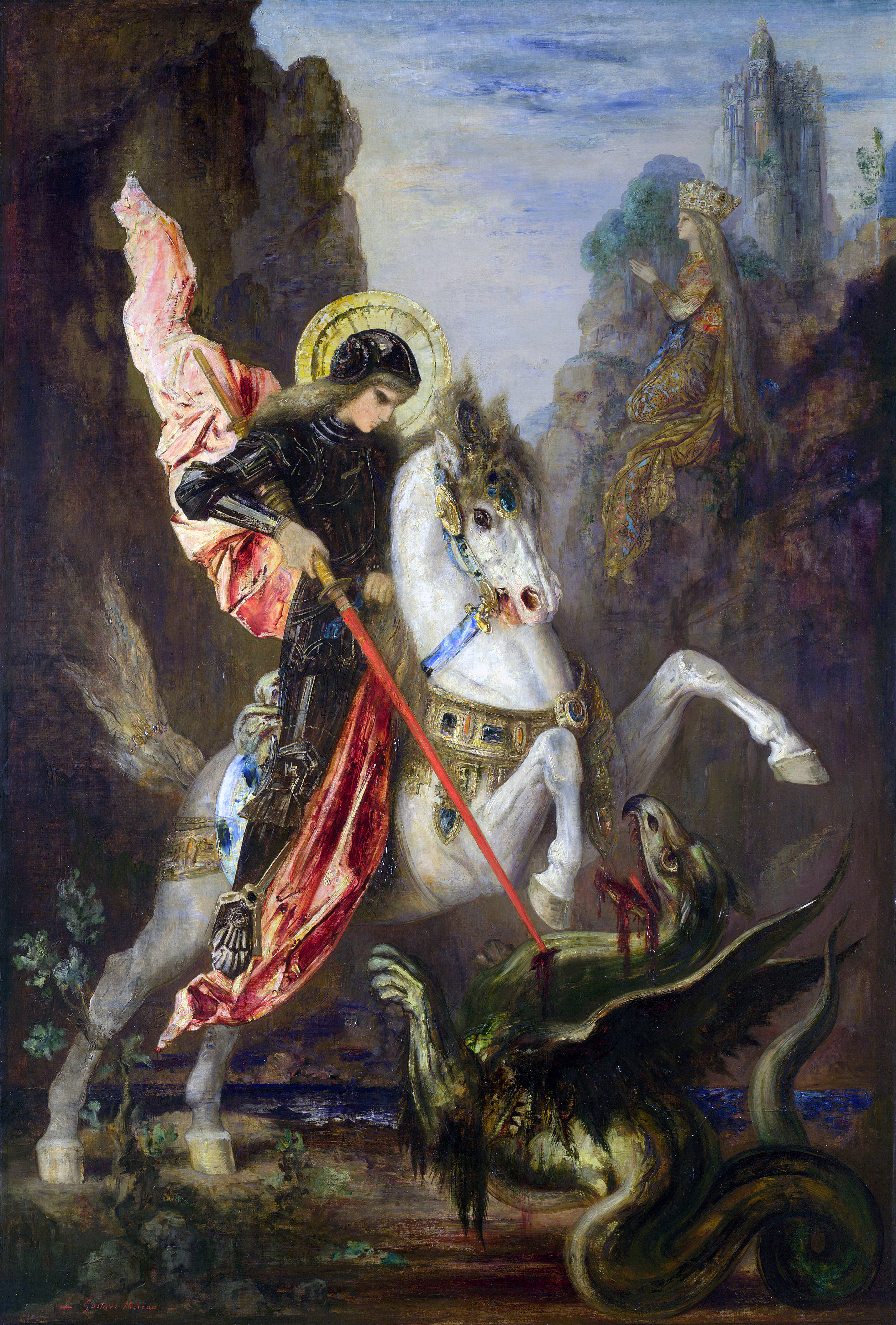
Consider the legend of Saint George and the Dragon:


Saint George and the Dragon by Gustave Moreau, 1889/1890

In the story, Saint George rescues the daughter of a Libyan king who is to be sacrificed as an appeasement to a plague-bearing dragon that had ravaged the countryside. Reinforcing himself with the Sign of the Cross, the knight charges the beast on horseback and seriously wounds it with his lance. He brings the creature to the city of Silene, where he slays the dragon in exchange for the people's conversion to Christianity.

What can we draw from this tale? The presence of evil, while lamentable in its own respect, presents us with the choice to submit to its influence or to be bearers of goodness and overpower its tenacious grasp. By helping others bear their burdens we affirm the love of God through our imitation of Christ. The evils that surround us may intimidate and sometimes paralyze us, but we can take solace in God's promise that He will deliver us unto redemption, so long as we are ready to reflect the love He has given us. This is "the benefit of dragons."

In developing this blog, Seminarian Daniel's presentation came to be a great motivation and inspiration. Through the exploration of everyday experiences I hope to expose the "dragons" that plague our existence and reframe those encounters as opportunities to draw closer to the one Lord who truly loves us. Indeed, we may find that theodicy is "the odyssey" to God...

Friday, August 21, 2015

*La vita è bella*

Few atrocities in our human existence inspire as much ire and horror as the Nazi concentration camps of the World War II period. Being sent to one was an unspoken death warrant. And yet this was the backdrop to the heartbreaking film, La vita è bella, or, as it's better known, Life Is Beautiful. The story follows a Jewish Italian librarian, played by Roberto Benigni, and his son who are sent to one such camp. All the while, Benigni's character uses his fortitude and imagination to shield his son from the barbarities of the camp, doing all he can to show him that, yes, life is in fact beautiful.

While we can all hope to never face such a gruesome reality in our own lives, the film highlights something that should readily resonate with us: There is suffering in this world. We all have our hurts, fears, insecurities... and we rarely ever completely shake them. Of course, we can't forget about the evils external to ourselves — war, disease, poverty, etc. And there is the ultimate evil: death. How, then, are we supposed to believe that "life is beautiful?"

Undoubtedly, similar thoughts crossed Christ's mind as He entered into and endured His Passion. The God-man who had not one offense to His Name was made to suffer and die like the common criminals crucified alongside Him. Still, He never defied the Father's will, and for His faithfulness He was rewarded with everlasting life. We are promised the same gift, despite our human imperfections, but we, like Christ, must persevere in the trials of this earthly life, while discerning and cherishing the countless hidden blessings He has given us.

I have been for some time considering writing a blog on living a good Christian life and coming to a (limited) understanding of how God works and reveals Himself in this world. It was after hearing this song that I found the inspiration and courage to pursue this form of ministry.


Upon hearing the second verse, I immediately knew what my focus would be: Exploring how living with God's grace through the "beauty and rage" (N.B. the album's titular lyrics) of this temporal life will help us to achieve the glory of eternity. Put another way: Learning how by suffering with Christ, here in our every moment, we experience God's redemptive love.

Perhaps some readers have noticed that my blog title includes the name of the band that so heavily influenced it. This was a deliberate action, but not merely a commemorative one. As lead singer Mike Barnes poetically describes it, the color red is a symbol "for the blood of Christ and what it represents: passion, pain, but ultimately redemption." How wonderfully beautiful is that?

Over the course of this intellectual and spiritual journey, I will be examining a wide range of topics — hopefully with input from my readership — in the Catholic perspective. However, I strongly encourage readers of any background, Christian and non-Christian alike, to join me in exploring the mysteries of the divine and in discovering new frontiers in the infinite essence of God. I pray the Holy Spirit will guide us in our travels and at life's end bring us to the glory of Heaven. Amen.